How to Improve Memory Power for Studying: 10 Effective Tips for Students
Memory is the foundation of learning. Students need not only to understand and learn information but also to retain it long enough to reproduce it during exams. Memory can be divided into two key aspects:
- Long-term retention – the ability to remember information over an extended period, such as recalling what you studied for an exam.
- Short-term sequential memory – the ability to retain ideas in the order they appear and connect one idea to the next, which is essential for comprehension.
Nowadays, many students face challenges with both types of memory. The good news is that memory is not fixed. It can be trained and strengthened through specific strategies, healthy lifestyle habits, and mental exercises. This guide provides research-backed tips to help you enhance your memory and maximize your study efficiency.
1. Revision Strengthens Memory
Studying a topic once is rarely enough to retain it for months. Learning naturally fades over time, which is why revision is essential. To strengthen memory, revisit topics periodically during the academic session. For example, after learning a topic, review it again after a month or two. Revising two or three times reinforces the learning and makes it a more permanent part of your memory.
Example: If you study the water cycle in science today, review your notes after one week, then again after one month. Each revision reinforces the information, making it easier to recall during exams.
No matter how thoroughly you study, if you do not revise, you are likely to forget it. Revision is a proven strategy for retaining knowledge and improving long-term memory.
2. Write Down Key Points and Read Aloud
Writing down important points while studying is highly effective. When you summarize key ideas on a separate sheet, your brain processes and stores the information more efficiently than when reading silently. Many students find that taking notes while studying helps them understand and retain information for longer periods. Additionally, these notes can serve as handy study materials for future revisions.
Example: While studying a chapter on photosynthesis, write down the key steps: sunlight absorption, chlorophyll function, glucose production. This helps you recall the process without rereading the entire chapter.
Another useful strategy is reading sentences aloud. Speaking the words allows your brain to learn both by reading and listening. This dual engagement enhances retention and helps you remember the material more effectively.
Example: When learning a new English poem, read each stanza aloud. This helps you memorize it faster than reading silently.
3. Associate Ideas to Enhance Recall
Research shows that associating new information with existing knowledge improves memory. When studying a topic, try to link each idea to another idea within the same topic. This is similar to remembering a story, where each event naturally connects to the next.
For example, in a long chapter with multiple points, creating intentional associations between ideas helps you recall the sequence and overall content more easily. Developing these mental links strengthens both short-term and long-term memory.
Example: If you are learning the causes of World War I, associate each cause with a familiar story: “The assassination of Archduke Franz Ferdinand is like the spark in a fireworks show, it triggers a bigger reaction.” This helps create meaningful mental connections.
Developing associations between ideas also helps retain sequential information. For instance, in a biology chapter about the human digestive system, visualize the sequence of organs as a journey through a factory: mouth → esophagus → stomach → intestines.
3. Build a Mental Sketch – Story Form for Complex Topics
For topics with multiple stages or processes, such as a chemistry experiment with several steps, it helps to create a mental sketch of the entire process. Then, convert it into a story-like sequence in your mind: “First this happened, then this happened,” and so on.
This story-based visualization allows you to remember complicated topics more easily, maintaining both the sequence and the details in a memorable structure.
Example: In chemistry, to remember the steps of a chemical reaction, imagine a mini-story: “First, I mix reactants in a beaker. Then, bubbles form. Finally, the product settles at the bottom.” The story creates a memorable sequence.
4. Use Abbreviations or Phrases for Complex Information
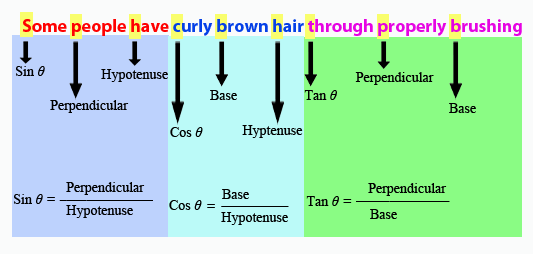
Books often contain formulas, equations, and specialized terms that must be memorized in their exact form. To make this easier, use abbreviations or mnemonic phrases.For example, consider the trigonometry formulas:
- Sin θ = Perpendicular / Hypotenuse
- Cos θ = Base / Hypotenuse
- Tan θ = Perpendicular / Base
A student might use the mnemonic: “Some People Have Curly Brown Hair Through Proper Brushing” to recall the formulas quickly and accurately during exams.
5. Physical Exercises
Physical exercise benefits memory by increasing blood flow to the brain and stimulating the release of hormones that enhance cognitive function. A simple daily walk is sufficient to support brain health.Brain exercises are equally important. Activities like puzzles, chess, scrabble, yoga, and recall games strengthen memory by actively engaging your brain. For instance, look at a scenery for a few minutes, then move to another room and try to recall all its details. Regular mental workouts improve both memory and concentration.
6. Practice Regular Mental Exercises
Just like muscles, your brain improves with training:- Solve puzzles, crosswords, or logic games.
- Learn a new language or musical instrument.
- Practice memory games or recall exercises.
These activities strengthen neural connections and enhance cognitive flexibility.
7. Eat a Brain-Healthy Diet
Certain proteins, vitamins, and minerals are vital for memory and brain function. Include foods rich in Omega-3 fatty acids, such as fish, to support cognitive health. Fruits and vegetables provide antioxidants like carotene and vitamin E, which protect brain cells. Reduce the intake of sugary foods, as excessive sugar can impair brain function. A balanced diet directly contributes to better memory and learning.
Example: Eat salmon or sardines for Omega-3, blueberries for antioxidants, and spinach for vitamin E. Avoid excessive sugary drinks that can disrupt focus.
8. Prioritize Quality Sleep
Sleep is critical for overall health and essential for memory consolidation. During sleep, the brain processes and stores information learned throughout the day. Adequate rest relaxes the brain and restores its capacity to retain and understand new information. Aim for seven to eight hours of quality sleep each night to maximize learning and memory power.
■ Final Thoughts
Improving memory power requires a combination of effective study habits, mental exercises, physical activity, proper nutrition, and sufficient rest. Techniques such as active revision, note-taking, reading aloud, forming associations, and creating story-based sketches can significantly enhance retention. Coupled with a healthy lifestyle, these strategies will help students remember more, learn efficiently, and perform better academically.
Memory is not fixed. It can be trained and strengthened with practice and consistency. By following these strategies, students can maximize their study efficiency and unlock their full academic potential.